Every leadership team claims to be data-driven. But ask them what that looks like in practice, and you’ll almost always get the same list: a modern warehouse, a BI tool, and a dashboard everyone pretends to check on Monday morning.
That isn’t a data-driven culture. That’s just reporting.
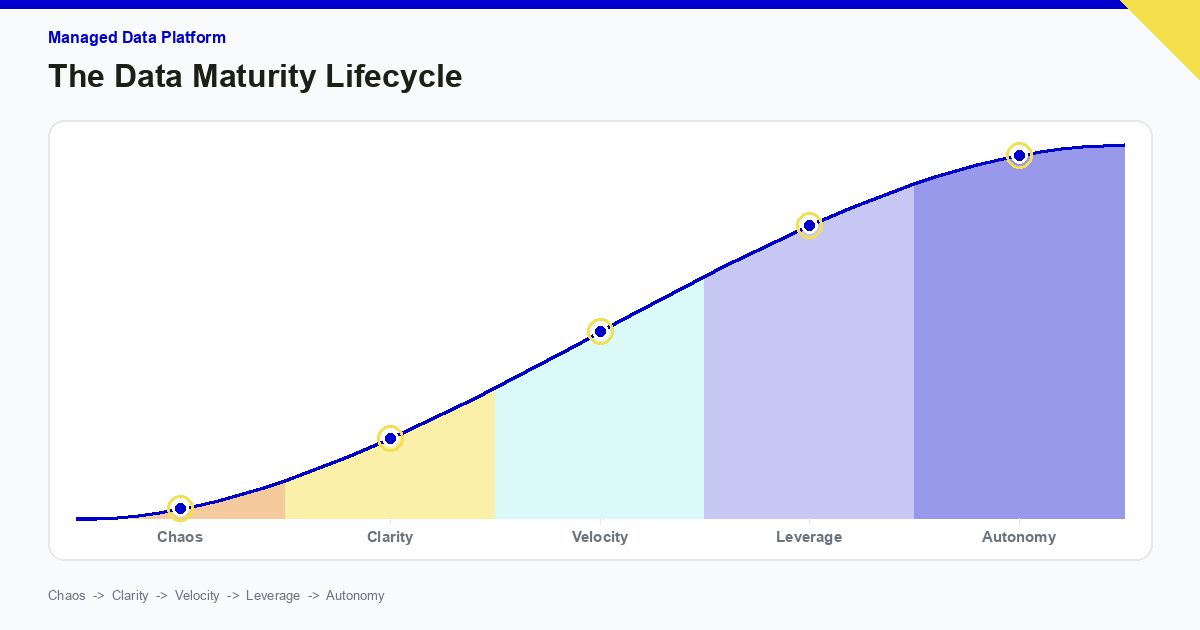
Reporting tells you what happened last month. Being data-driven changes what your team actually does next. The gap between the two isn’t a mindset issue. It’s a systems progression. Companies don’t jump straight from spreadsheet chaos to autonomous AI agents overnight. They work their way through five distinct operational stages, each with its own specific operational bottleneck.
We built our data maturity diagnostic around these exact stages: 🚫 Chaos → 📊 Clarity → ⚡ Velocity → 🤖 Leverage → 🚀 Autonomy.
Here is how to figure out where your organization actually stands, and how to get to the next level.
Stage 1: 🚫 Chaos
In Stage 1, metrics live wherever the work gets done. Marketing tracks acquisition in Google Analytics, sales quotes revenue numbers directly out of Salesforce, and finance tracks burn rate in a massive, fragile Excel sheet.
- The Reality: Ask three department heads for your Customer Acquisition Cost (CAC) and you will walk away with three wildly different numbers, and three reasons why the other two are wrong.
- The Bottleneck: Executive alignment. Every leadership meeting devolves into an argument over whose spreadsheet contains the “real” numbers rather than how to fix the actual business.
- The AI Truth: You are nowhere near ready. Feeding unstructured, unverified, and conflicting data into an LLM just gives you wrong answers delivered with high confidence.
Stage 2: 📊 Clarity
Stage 2 is where most well-funded companies land and immediately stop, mistaking infrastructure for maturity. You’ve centralized your data into a cloud warehouse, built a single source of truth, and given everyone access to a clean executive dashboard.
- The Reality: LTV, CAC, and churn finally mean the same thing in every room. Everyone agrees on the numbers.
- The Bottleneck: Human action. You know exactly what happened yesterday, but your front-line managers are still staring at static charts, trying to manually figure out what to do about it.
- The AI Truth: Good enough for basic natural-language SQL queries and internal reporting bots. Not nearly structured or contextual enough for high-stakes business automation.
Stage 3: ⚡ Velocity
Stage 3 is where data stops being something you look at and starts being something you work with. trusted, centralized metrics are pushed back into the daily tools your team actually uses: your CRM, support desk, and marketing platforms.
- The Reality: An account executive doesn’t need to open a Looker dashboard to notice a drop in product usage; the alert appears directly on the account record in Salesforce. Department leads write their own ad-hoc reports without opening a data ticket.
- The Bottleneck: Human bandwidth. Your team receives the right signals early, but they still spend hours every week manually reading tickets, stitching context together, and taking action one step at a time.
- The AI Truth: This is the baseline required to build AI that actually works for your business. You finally have clean history, structured event streams, and defined business rules.
Stage 4: 🤖 Leverage
At Stage 4, AI transitions from a fun experiment to a core operational multiplier. Because your core metrics, customer interactions, and internal SOPs are organized, generative tools can finally assist with complex, multi-step tasks.
- The Reality: Account executives can pull a comprehensive three-year account history and opportunity brief in five seconds. Support reps get instant, highly accurate response drafts pulled directly from your internal documentation, not generic web training data.
- The Bottleneck: Manual sign-off. AI drastically speeds up preparation and thinking, but a human still has to trigger, review, and approve every single action.
- The AI Truth: Co-pilots thrive here. They eliminate repetitive grunt work while keeping humans firmly in the loop to make judgment calls and handle tone.
Stage 5: 🚀 Autonomy
Stage 5 is where operational workflows run by default. AI systems don’t just draft solutions for human review; they handle end-to-end execution for standard cases and route exception handling to your team.
- The Reality: An agent detects an early churn risk from telemetry data, generates a targeted retention offer, delivers it via email, and only alerts an Account Manager if the case hits an edge case or exceeds a certain deal value.
- The Bottleneck: Risk management, edge cases, and continuous governance. The work shifts from executing tasks to monitoring system performance so workflows don’t drift over time.
- The AI Truth: Your proprietary operational data constantly improves your internal models, creating a moat that competitors relying on out-of-the-box software can’t easily replicate.
Moving Up the Curve
You cannot skip steps. Buying an expensive enterprise chatbot when your sales and finance teams are still fighting over revenue metrics is a recipe for expensive failure.
Each phase requires solving a very specific problem before moving forward:
1. Moving from 🚫 Chaos to 📊 Clarity
Stop worrying about dashboards and fix your definitions. Pick 5 to 10 core metrics (ARR, active users, net retention) and force leadership to agree on exact mathematical definitions. Build a centralized cloud data warehouse, pick one painful operational issue (like trial conversion or customer churn), and resolve the data pipeline for that single issue first.
2. Moving from 📊 Clarity to ⚡ Velocity
Take data out of cold storage and put it into operational motion. Set up reverse ETL pipelines to feed clean warehouse data straight into Salesforce, Zendesk, or HubSpot. Stop relying entirely on lagging metrics like monthly revenue and start surfacing actionable, leading indicators like weekly feature usage directly to front-line staff.
3. Moving from ⚡ Velocity to 🤖 Leverage
Clean up your qualitative data. Start organizing call transcripts, ticket histories, and internal SOPs so models have actual domain knowledge to reference. Secure your data permissions early so internal models only surface information users are authorized to see, then roll out targeted co-pilots for repetitive internal tasks.
4. Moving from 🤖 Leverage to 🚀 Autonomy
Identify low-risk, high-volume workflows where an error is cheap to fix. Write explicit boundaries for when an agent can execute an action automatically versus when it must escalate to a team member. Track accept, edit, and rejection rates on AI-generated suggestions to pinpoint exactly where the system is ready to take the reins.
The Four Diagnostic Tests
If you want to know whether your organization is genuinely data-driven or simply good at reporting, evaluate your team against these four realities:
- You argue about strategy, not metric definitions. If the first twenty minutes of your leadership meeting are spent debating whose numbers are correct, you are still in Chaos. Data-driven teams start the meeting agreeing on the facts and spend their time deciding what to do about them.
- Signals live where work gets done. If your account managers have to leave their CRM, log into a separate analytics tool, and filter three dropdowns just to see if a customer is onboarding successfully, your data is stalled at Clarity.
- Teams act on playbooks, not manual extracts. If answering a routine business question requires pulling CSVs and waiting three days for an analyst, your operations are bottlenecked. Data-driven organizations rely on automated triggers, clear alerting rules, and inline assistance.
- AI builds on your actual institutional knowledge. If your team’s use of AI is limited to personal ChatGPT tabs cut off from company context, you aren’t leveraging AI. Real operational AI leverages your documentation, ticket history, and CRM data to execute real work.
Building a warehouse gives you infrastructure. Setting up dashboards gives you literacy. But becoming truly data-driven is an operational habit: it means trusted data changes your next action automatically, in the flow of daily work, without needing a committee meeting to figure out what happened last month.
Where are you on the curve?
Take our five-question data maturity diagnostic to pinpoint your current stage, identify your primary bottleneck, and get a clear action plan. If you're ready to build out your warehouse and reporting layer without the overhead of hiring an entire in-house data team, explore our Managed Data Platform.